Ball Sort Game - Color Puzzle
Words MobilePuzzle
4.92.57K Reviews
- Version
- 5.3
- Installs
- 1.00M
- Age Rating
- Everyone
Screenshots
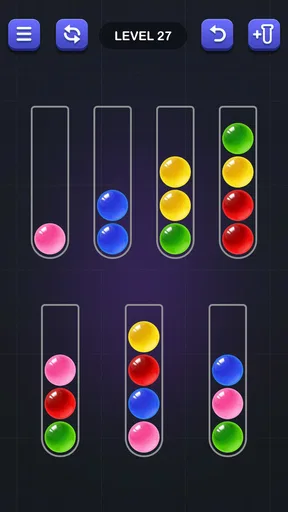
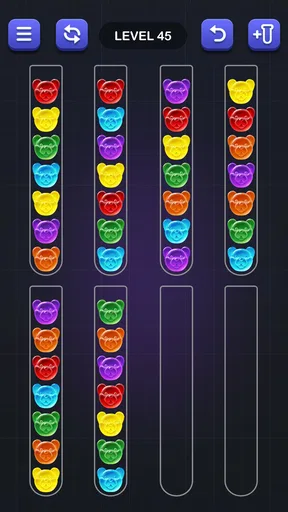
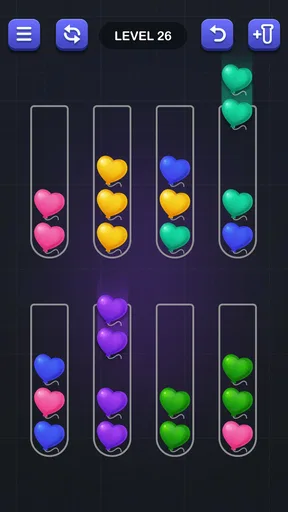
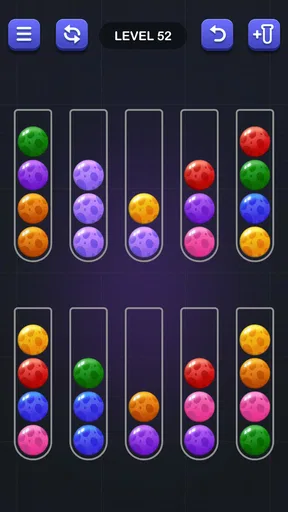
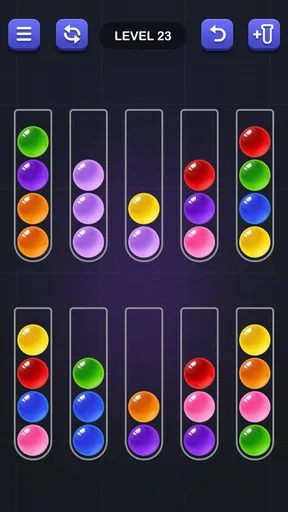
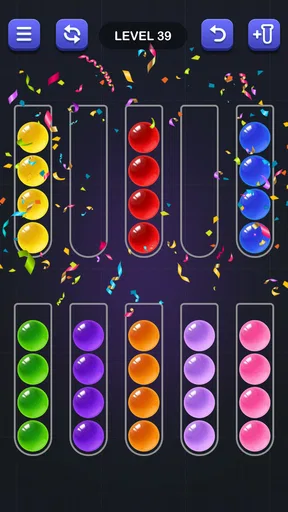
Our Review of Ball Sort Game - Color Puzzle
 Analysis by Appyee
I found Ball Sort Game - Color Puzzle easy to understand within a few seconds, but not so simple that every level feels automatic. The idea is familiar: colored balls sit in tubes, and I move them until each tube contains one color. What makes the experience work is the small amount of planning required before every tap. A move can look helpful while quietly blocking the only useful space later.
This is a free puzzle game from Words Mobile, aimed at Everyone and available for devices running Android 5.0 or later. It belongs to the casual brain-training side of mobile gaming rather than the fast-action puzzle group. The store summary calls it a relaxing brain puzzle, and that description matches my first impression: it is best played in short, quiet sessions when I want something to occupy my attention without demanding a long commitment.
The game has reached over a million installs and holds a 4.9 average from roughly seventy-four thousand ratings, with about two thousand six hundred written reviews. Those figures suggest that the basic formula connects with a broad audience, although popularity does not remove the small points of friction that can appear during play. I would judge it mainly by how comfortably it fits into everyday use, not by its impressive store presence alone.
Where the puzzle experience can get stuck
The first place many players are likely to struggle is not the rule itself but the order of moves. A tube may have room for a color, yet pouring into it can trap another ball underneath the wrong arrangement. I quickly learned to pause before touching the screen and identify which top balls are currently movable, which empty spaces are available, and which tube needs to remain open as a temporary buffer.
That buffer is the most important practical resource in a level. Treating every empty tube as a final destination usually creates trouble. I get better results when I reserve one open tube for short-term parking and use the other spaces to build completed colors. This approach is especially useful when several tubes contain similar-looking stacks and the next legal move is not obvious.
Another common sticking point is visual scanning. When the screen contains many colors, I can focus too closely on the ball I want to move and overlook the tube that must receive it. My workaround is to read the board from top to bottom first, then follow one color through all tubes. That turns a messy layout into a small checklist: find the exposed ball, locate its matching destination, and confirm that the move will not consume the only spare space.
The game is relaxing, but “relaxing” does not mean every puzzle is solved by random tapping. If I make several speculative moves in a row, I can reach a position where the board still looks active but no useful route remains. The lesson is simple: undoing a thoughtless move is less efficient than spending a few seconds planning it. Players who enjoy careful logic will probably appreciate this; anyone expecting a purely automatic time filler may find the later puzzles more demanding than the short description suggests.
There is also a psychological trap in completing one color too early. A finished tube feels like progress, but it can remove a flexible landing place if the remaining colors need that space. I now ask whether a completed tube is genuinely helping or merely making the board look tidier. Keeping a partially useful tube available can be the better decision until the surrounding colors are organized.
What to check before blaming the game
Because the game is built around direct taps and pours, setup problems can feel like puzzle mistakes. Before assuming that a move is impossible, I check that I am touching the visible ball rather than the empty area above it. I also make sure the destination tube has enough room for the matching color. A legal-looking move can fail simply because the receiving tube is full or has a different color at its top.
On a smaller phone, crowded tubes can make precise selection less comfortable. I find it easier to use a deliberate single tap instead of repeatedly tapping while trying to correct a missed selection. If the screen is busy, I slow down and target the center of the ball. This is not a complicated setting, but it prevents a surprising amount of frustration during a tight sequence.
The minimum operating-system requirement is Android 5.0, so the game is accessible on older compatible Android devices. That does not guarantee identical comfort on every screen size or hardware configuration. A player using an older phone should judge the experience by touch accuracy and display clarity as much as by whether the game installs successfully.
When I begin a session, I prefer to make sure the phone is responding normally, the game has finished opening, and no other touch-heavy activity is competing for attention. If taps seem delayed, I avoid rapidly repeating them. Repeated input can make it harder to tell whether the original action registered, especially in a puzzle where one incorrect move changes the whole arrangement.
It is also worth separating a puzzle rule from a technical issue. If a ball will not move, I first check whether it is exposed at the top of its tube and whether the target has matching color space. If both conditions are satisfied and the tap still does nothing, I try a calm second selection rather than making several unrelated moves. This simple check keeps a temporary touch problem from turning into a ruined attempt.
Recovering a promising board after a poor move
My preferred recovery method is to stop immediately after noticing a mistake. Continuing to play can bury the original error under several more moves and make it difficult to remember what changed. I retrace the last action mentally: which ball moved, which tube lost its open space, and whether that move blocked a color that was previously accessible.
If the current position still has a spare tube and at least one useful matching move, I continue from there rather than restarting emotionally. The key is to restore flexibility. I move a top ball only when it either joins its color, opens a buried ball, or creates a better temporary arrangement. A move that does none of those things is usually just adding risk.
When the board feels unsalvageable, restarting can be more sensible than forcing it. I do not treat that as failure; sorting puzzles are experiments in ordering, and a first attempt often reveals which color must be handled earlier. On a second attempt, I remember the dangerous bottleneck instead of repeating the same attractive but unhelpful move.
A useful recovery habit is to work backward from the color that is hardest to expose. If one shade is buried under several other balls, I prioritize opening its path even when another color appears closer to completion. This is a more reliable strategy than simply finishing whichever tube looks easiest. It also gives the game more depth than its calm presentation might suggest.
I recommend keeping a mental distinction between “progress” and “freedom.” Progress means placing matching balls together; freedom means preserving enough empty capacity to continue. A good move often improves both. A risky move improves only progress while reducing freedom. Once I started evaluating both, I made fewer dead-end choices and needed fewer restarts.
When the app may not be the cause
Some frustrations come from the nature of sorting puzzles rather than from the software. If a level seems repetitive, that may reflect the deliberate simplicity of the format: the challenge comes from arrangement, not from changing characters, story scenes, or action mechanics. Players looking for constant novelty should know that the appeal here is the gradual satisfaction of solving layouts, not a stream of new gameplay genres.
Likewise, a difficult board is not automatically broken. I first look for an overlooked empty tube, a matching ball hidden beneath another color, or a move that requires temporary parking instead of immediate completion. The most convincing sign of a real problem would be a legal move that repeatedly fails under the same conditions, but I would check selection and destination space carefully before reaching that conclusion.
Device behavior can also influence the experience. A busy phone, an unresponsive touch area, or an older display may make accurate selection feel inconsistent. Closing unrelated activity, waiting for the board to respond, and tapping once with intention are sensible first steps. These are general checks, but they matter more here because one accidental input can change a carefully planned position.
The game is not the best choice for someone who wants social competition, a narrative campaign, or a strong sense of progression beyond solving the next arrangement. It is also less suitable for players who dislike restarting after a poor sequence. By contrast, it fits people who enjoy quiet concentration, short breaks, and puzzles that can be understood without reading a long tutorial.
Compared with match-three games, this one removes the pressure of falling pieces, timed turns, and chain reactions. Compared with word puzzles, it relies on spatial planning rather than vocabulary. Traditional logic-grid puzzles usually ask for more written deduction, while this game keeps the reasoning visible on the screen. I prefer it when I want a clean visual problem that I can stop and resume mentally without tracking a story or a large set of rules.
How I would use it in an ordinary day
Imagine waiting for a bus or sitting through a short break at work. I can open a level, solve a few moves, and put the phone away without needing to remember a complex control scheme. The best routine is not to rush through as many boards as possible. I use the first moments to inspect the color stacks, choose a temporary tube, and decide which buried color is likely to cause trouble.
It also works as a wind-down activity, provided I accept that a puzzle may require more attention than expected. The absence of fast action makes it calmer than many arcade alternatives, but the need to plan can still keep my mind engaged. If I am tired and start tapping randomly, the relaxing quality disappears. In that situation, I either slow down or choose something less mentally demanding.
For a younger player, the Everyone age classification makes the game broadly approachable, and the rules are easy to explain without advanced reading. I would still encourage a child to treat it as a thinking activity rather than a race. For an older family member, the color-based layout may be more immediately understandable than a word-heavy puzzle, though screen size and color visibility remain practical considerations.
One of my favorite small techniques is to name the tubes by position while planning: left, middle, right, and so on. I then describe the intended sequence in my head before tapping. This reduces accidental moves and makes it easier to recover if I lose track. It sounds minor, but it is particularly helpful when several tubes share the same top color.
Another useful technique is to avoid filling the last open tube until I know what it is for. That space is often more valuable as a staging area than as a permanent home. I also try to expose a buried ball before committing to a long chain of same-color pours. These habits are not visible in the short store summary, yet they make a noticeable difference in how consistently I solve the layouts.
What the current release means for new players
The current version is 5.3, and the game is free to download. That makes it easy to try without treating the first session as a major commitment. I would begin with a few levels rather than deciding immediately whether it is a long-term favorite. The central mechanic reveals its appeal quickly, while the more meaningful question is whether I enjoy planning around limited space.
Words Mobile has kept the identity focused on the sorting idea rather than surrounding it with a complicated premise. That focus is a strength for quick access: I know what kind of attention the game expects as soon as the board appears. It is also a limitation for players who need varied objectives, changing environments, or a richer sense of discovery to stay interested.
The high average rating and large install base make the game look like a safe recommendation, but I would still match it to the right person. Someone who likes tidy visual systems and solving one contained problem at a time will probably understand the appeal. Someone who wants constant rewards, multiplayer interaction, or a story-driven reason to continue may prefer another type of puzzle.
In practical terms, I would install it on a compatible Android phone, play slowly at first, and keep the spare tube in mind as a resource rather than an empty decoration. If a move appears blocked, I would verify the top-ball and destination rules before assuming anything is wrong. If I make a bad sequence, I would stop, identify the bottleneck, and restart with a better order instead of tapping through frustration.
My final view is positive, with a clear qualification: Ball Sort Game - Color Puzzle is strongest as a focused, low-pressure sorting challenge, not as an all-purpose mobile game. I like that it can fill a short pause, reward careful thinking, and remain understandable without a lengthy introduction. Its main weakness is equally clear: the simple format may feel narrow, and a careless move can turn a calm session into a tedious recovery.
For me, the balance works. I would recommend it to a friend who wants a free color puzzle for quiet breaks and enjoys planning several moves ahead. I would point that friend toward the temporary-space strategy, careful tapping, and early attention to buried colors. If those habits sound satisfying rather than restrictive, this is a worthwhile download; if they sound like work, a faster match-three or more varied logic game would be a better fit.
Verdict
Strengths of Ball Sort Game - Color Puzzle
- Simple rules make it easy for anyone to start playing.
- Offline support lets you enjoy puzzles without an internet connection.
- Short levels are convenient for quick gaming sessions.
- Colorful visuals make the tubes and balls easy to distinguish.
- Increasing difficulty provides a steady challenge for puzzle fans.
Limitations of Ball Sort Game - Color Puzzle
- Later levels can feel repetitive after extended play.
- Some stages may require trial and error rather than pure logic.
- Hints or extra moves may be limited or tied to advertisements.
- Frequent ads can interrupt the flow between completed levels.
- Color-based gameplay may be difficult for some colorblind players.
Other Releases by Words Mobile
View All
Crossword Quest
Word4.7

Traffic Master - Jam Buster
Puzzle4.8
Similar Picks in This Category
View All
Block Blast!
HungryStudio4.8

Braindom: Brain Games Test
Lahana Game Studio4.6

AMAZE!
CrazyLabs LTD4.6

Sudoku - Classic Sudoku Puzzle
Oakever Games4.7

Art Puzzle - Puzzle Games
Easybrain4.8

Amaze GO!
Oakever Games4.9
Frequently Asked Questions
What is Ball Sort Game - Color Puzzle?
Ball Sort Game - Color Puzzle is a casual sorting game in which you move colored balls between tubes until every tube contains balls of only one color. The rules are easy to understand, but later levels require careful planning because each tube has limited space. It is designed for short sessions, relaxing play, and gradually more challenging puzzles.
How do you play Ball Sort Game - Color Puzzle?
To play, tap or select a tube to pick up the top ball, then choose another tube where the ball can be placed. Usually, you can move a ball only onto an empty tube or onto a ball of the same color, provided there is enough room. The objective is to organize all matching colors into separate completed tubes without getting stuck.
Does Ball Sort Game - Color Puzzle work offline?
The main sorting puzzles can generally be played without a continuous internet connection, which makes the game convenient for travel, commuting, or quick breaks. However, certain features may depend on connectivity, including advertisements, optional rewards, cloud synchronization, updates, or promotional content. If offline access is important to you, test the game after disabling mobile data and Wi-Fi.
Are there hints, undo moves, or ways to restart a puzzle?
Ball Sort Game - Color Puzzle commonly includes helpful tools such as undoing a recent move, restarting the current level, or receiving a hint when the solution is difficult to find. Their availability and cost can vary by version or level. These options are useful for beginners, although relying on them too often may reduce the strategic challenge of solving puzzles independently.
Is Ball Sort Game - Color Puzzle free, and does it contain advertisements?
The game is typically free to download and play, but it may be supported by advertisements and optional in-app purchases. Ads can appear between levels or when you request extra hints, moves, or other rewards. Before downloading, check the store listing for the current pricing, advertising policy, age rating, and purchase details, especially if children may use the device.
Play our best games!


